“Promoted to Glory” – Peace Beyond Death
To the best of my knowledge, the main book for sale on this page is consistent with all main stream Christian philosophy. However, this Article on “Promoted To Glory” is very “Salvation Army.” Since it has bought me great peace, I freely share it with you.
Please see the Pictorial Summary at the end of this Article.
Few Christian expressions are as moving, hopeful, and uplifting as the Salvation Army phrase “Promoted to Glory.” Rather than saying a believer has “died,” the Salvation Army often says they have been “Promoted to Glory.” Those three simple words completely change the emotional tone surrounding death. Instead of focusing on loss, darkness, fear, and endings, the phrase points toward victory, reward, peace, and eternal life with God.
For many people, especially those entering their later years, this phrase carries enormous comfort. It does not deny sadness. It does not pretend grief is unreal. But it places earthly suffering into a much larger eternal perspective.
For Christians, death is not the final chapter. It is a doorway. It is not defeat. It is promotion. It is not extinction. It is entrance into eternal glory with Jesus Christ.
This article explores the meaning behind the Salvation Army slogan “Promoted to Glory,” why it is emotionally easier than speaking only about “dying,” the struggles many elderly people face in later life, and the Biblical promises of eternal paradise that give Christians hope and peace.
Part One: What Does “Promoted to Glory” Mean?
The Salvation Army has used the phrase “Promoted to Glory” for many generations. It reflects the belief that faithful Christians do not simply cease to exist when they die. Instead, they are welcomed into the presence of God.
The word “promotion” is important.
A promotion suggests advancement. It suggests moving upward into something better. In earthly life, a promotion usually means increased honour, greater reward, or moving into a more important role. The Salvation Army applies this idea spiritually.
For a Christian, earthly life is not the final destination. Heaven is.
When believers leave this world, they are not being cast aside. They are being elevated into eternal glory with Christ.
The phrase is deeply rooted in Scripture. The Apostle Paul wrote:
“I have fought the good fight, I have finished the race, I have kept the faith.”
— 2 Timothy 4:7
Paul viewed life as a race and Heaven as the reward waiting at the finish line. He also wrote:
“To be absent from the body is to be present with the Lord.”
— 2 Corinthians 5:8
For Christians, death means entering the direct presence of God.
The Salvation Army’s expression also reflects military imagery. Since the Salvation Army uses military-style language such as officers, soldiers, uniforms, and corps, the phrase “Promoted to Glory” fits naturally into that structure. A faithful Christian soldier completes their earthly service and is promoted into the eternal Kingdom of God.
This outlook transforms how believers think about life and death. Instead of viewing death as the terrifying collapse of existence, Salvation Army Christians see it as the completion of their earthly mission.
Instead of seeing a grave as an ending, they see Heaven as a beginning. Instead of focusing only on what has been lost, they focus on what has been gained.
This does not remove grief entirely. Jesus Himself wept at the tomb of Lazarus. Christians still mourn separation from loved ones. But grief mixed with hope is very different from grief mixed with despair.
Paul explained this beautifully:
“We do not grieve like the rest of mankind, who have no hope.”
— 1 Thessalonians 4:13
That single sentence captures the heart of “Promoted to Glory.”
Part 2:
Why “Promoted to Glory” Feels Easier Than “Dying”
Words matter deeply. The language people use shapes emotions, attitudes, and expectations. The word “dying” often carries feelings of fear, helplessness, pain, darkness, and finality. Many people associate death with hospitals, funerals, decline, and separation.
The phrase “Promoted to Glory” changes the emotional picture completely.
Instead of focusing on loss, it focuses on destination.
Instead of focusing on weakness, it focuses on victory.
Instead of focusing on fear, it focuses on hope.
Human beings naturally fear death because death feels unknown. Even strong believers sometimes feel anxious about the process of dying. Questions arise:
Will there be suffering?
Will I lose my dignity?
What happens after death?
Will I see loved ones again?
Will I face judgment?
The phrase “Promoted to Glory” gently redirects the mind away from terror and toward trust in God. It reminds believers that Jesus has already conquered death.
When Jesus rose from the grave, Christians believe He defeated the power of death forever. Paul triumphantly declared:
“Death has been swallowed up in victory.”
— 1 Corinthians 15:54
And then:
“Where, O death, is your victory? Where, O death, is your sting?”
— 1 Corinthians 15:55
For Christians, death still exists physically, but it no longer has ultimate power.
The phrase “Promoted to Glory” also acknowledges that this world is not perfect. Earthly life contains beauty, love, joy, and meaning. But it also contains suffering, injustice, sickness, grief, disappointment, and pain.
Many elderly believers eventually reach a point where they feel tired. They may still love life deeply, but they recognise the burdens of ageing. The thought of Heaven becomes less frightening and more comforting.
The expression “Promoted to Glory” recognises this transition.
It suggests arriving home after a long journey.
It suggests rest after exhaustion.
It suggests healing after suffering.
It suggests reunion after separation.
It suggests peace after struggle.
This perspective can completely transform how older Christians emotionally process the end of life. Instead of seeing only decline ahead, they see eternity waiting ahead.
That is an extraordinary emotional and spiritual comfort.
Part 3: The Struggles of Ageing — And the Peace of Eternal Hope
The later decades of life often bring enormous challenges. People between 70 and 100 years of age frequently face problems that younger people rarely understand fully.
Physical strength declines.
Mobility becomes harder.
Pain increases.
Medical appointments multiply.
Friends pass away.
Independence reduces.
Simple tasks become difficult.
The body gradually weakens.
For some elderly people, the emotional burden can become just as heavy as the physical burden.
Loneliness becomes common.
Isolation increases.
Depression can quietly emerge.
Memory loss may appear.
Anxiety about health grows stronger.
Many older people mourn the loss of abilities they once took for granted.
A person who once drove confidently may no longer be able to drive safely.
A person who once cared for others may now need care themselves.
A person who once worked hard daily may now feel forgotten or useless.
This can create deep sadness.
Society often celebrates youth, speed, beauty, and productivity. Elderly people sometimes feel invisible. Some feel like burdens. Others quietly fear becoming dependent upon family members or nursing staff.
The mental strain can become overwhelming.
There is also the painful reality of watching lifelong friends disappear one by one. Entire worlds of shared memories gradually vanish. A person may outlive siblings, spouses, school friends, neighbours, and lifelong companions.
Grief accumulates.
The world changes rapidly.
Technology changes.
Culture changes.
Communities change.
Many elderly people quietly feel left behind.
In these moments, the Christian promise of eternal life becomes incredibly precious.
The phrase “Promoted to Glory” offers hope that suffering is temporary.
The Bible repeatedly reminds believers that earthly suffering will not last forever.
Paul wrote:
“Our light and momentary troubles are achieving for us an eternal glory that far outweighs them all.”
— 2 Corinthians 4:17
For someone enduring chronic pain, declining health, or emotional exhaustion, those words carry tremendous comfort.
The Christian hope is not merely about surviving death. It is about entering complete restoration.
In Heaven, there will be no failing bodies.
No dementia.
No wheelchairs.
No arthritis.
No cancer.
No depression.
No loneliness.
No fear.
The elderly believer can look beyond the limitations of ageing and see something glorious ahead.
The Christian faith also gives dignity to elderly people. Their value does not disappear because their physical abilities decline. Their worth comes from being loved by God.
An older Christian may no longer be physically strong, but spiritually they may possess enormous wisdom, compassion, patience, and faith developed over decades.
Many elderly believers radiate remarkable peace. Younger people sometimes notice this. After a lifetime of walking with God, many older Christians develop a calm confidence about eternity.
They know where they are going.
That certainty changes everything.
When a believer understands they are not simply “dying” but being “Promoted to Glory,” fear often softens into peace.
Not always perfectly.
Not without emotion.
Not without tears.
But with hope.
Deep hope.
Part 4: Biblical Promises of Eternity in Paradise
The Christian hope of Heaven is not based merely on wishful thinking. It is rooted throughout Scripture.
Jesus Himself spoke often about eternal life.
He promised:
“In my Father’s house are many rooms… I am going there to prepare a place for you.”
— John 14:2
This verse paints Heaven as a prepared home. Not an abstract idea. Not a vague spiritual cloud. A real place prepared by Christ Himself.
Jesus also told the repentant thief on the cross:
“Today you will be with me in paradise.”
— Luke 23:43
Paradise.
That single word contains extraordinary beauty.
The Book of Revelation gives some of the most powerful descriptions of eternity found anywhere in the Bible. These promises bring enormous comfort to believers facing ageing, suffering, or death.
One of the most beloved passages says:
“He will wipe every tear from their eyes. There will be no more death or mourning or crying or pain.”
— Revelation 21:4
This promise speaks directly to human suffering.
No more pain.
No more funerals.
No more grief.
No more hospitals.
No more suffering bodies.
No more tears.
For elderly people who may have endured decades of hardship, this promise is breathtaking.
Revelation also describes the eternal presence of God: “Now the dwelling of God is with men, and He will live with them.”
— Revelation 21:3
Christians believe Heaven’s greatest joy is not golden streets or beautiful scenery. It is being forever with the Lord.
Perfect love.
Perfect peace.
Perfect safety.
Perfect belonging.
The Bible also promises complete renewal:
“I am making everything new!”
— Revelation 21:5
Everything.
Broken hearts.
Broken bodies.
Broken minds.
Broken relationships.
Broken creation itself.
All restored.
Revelation describes a place where darkness disappears:
“There will be no more night.”
— Revelation 22:5
No fear.
No uncertainty.
No hidden evil.
Only the light of God forever.
The final chapters of Revelation present eternity not as boredom or emptiness, but as fullness of life in God’s perfect Kingdom.
Psalm 16:11 beautifully summarises this hope:
“In your presence there is fullness of joy; at your right hand are pleasures forevermore.”
Forevermore.
That is the heart of Christian hope.
Not extinction.
Not oblivion.
Not endless darkness.
But eternal joy with God.
Conclusion: “Promoted To Glory” – A Better View Than “Dying”
The Salvation Army phrase “Promoted to Glory” carries profound wisdom and comfort.
It reminds believers that earthly life is temporary, but eternity with God is forever.
It changes the emotional picture surrounding death.
It offers hope to the elderly.
It brings peace during suffering.
It points beyond physical decline toward eternal restoration.
For people facing the realities of ageing, illness, loneliness, or approaching death, the phrase becomes deeply meaningful. It acknowledges hardship honestly while still proclaiming hope triumphantly.
Christians do not deny the pain of this world.
But they also refuse to believe that pain has the final word.
Jesus Christ has the final word.
And His promise is eternal life.
For the believer, the end of earthly life is not merely dying.
It is being Promoted to Glory.
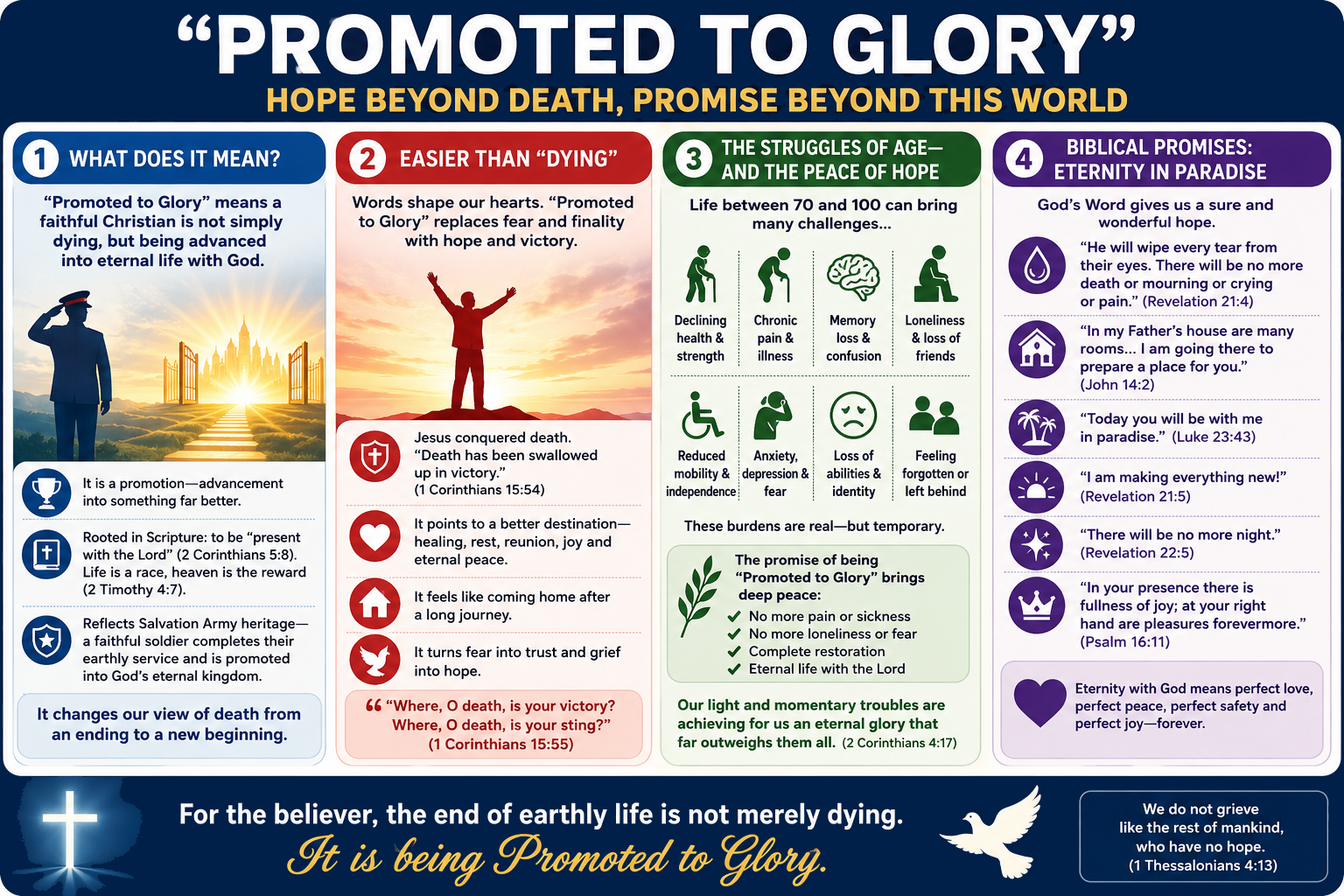
I hope you enjoyed this “Promoted to Glory” Article. Be at Peace – God is In Control!